

How to Authenticate an MCM Bag – Plaque, Serial Number & Visetos
MCM is back – and the hype has brought the fakes with it. The Visetos monogram is one of the most copied patterns in existence: a printed canvas is far easier to imitate than a hand-stitched leather bag. The good news is that fakes almost always fail in the same places.
In this guide we walk through the details we check ourselves at 9ine Life before a bag goes online – from the brass plaque to the condition of the edges. Every detail photo comes from our own stock and shows several genuine variants side by side, so you can see how wide the range actually is on authentic bags.

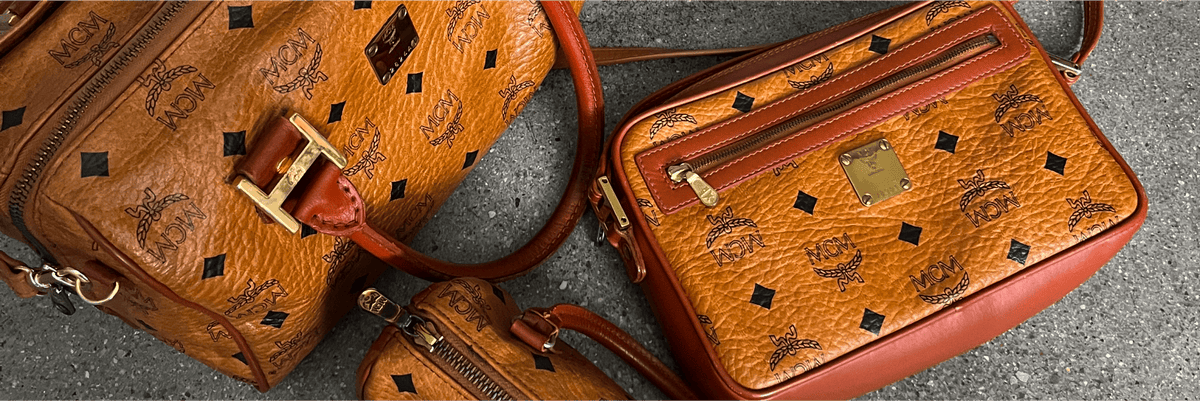
Two genuine MCM bags in Visetos cognac – different models, same hallmarks. These are the details we are about to go through.
The 60-second check
1. Count the laurel leaves. Nine on the left, eight on the right. This is where most copies fall down.
2. Look for both markings. A short code on the plaque and an article number on the fabric label – if one of them is missing, be careful.
3. Touch the plaque. Rounded corners, a flat surface, lettering in double lines – and never filled in black.
You can find our authenticated second-hand MCM bags here
1. The brass plaque – your most important clue
Almost every MCM bag carries a solid metal plaque on the front. It is the detail most fakes give themselves away on:
| Detail | On the original |
|---|---|
| Shape | Rectangular with rounded corners. Sharp corners are a warning sign. |
| Surface | Flat and even, with a rich gold tone. Wavy or thin-looking plaques argue against it. |
| Lettering | MCM in double lines, with “MÜNCHEN” underneath on most models. |
| Laurel leaves | Nine leaves on the left, eight on the right. The detail authentication services cite most often – counterfeiters almost always miscount. |
| Screws | Rounded slotted screws or rivets – never star screws. |
| Engraving | Never filled in black. Shaky or blackened engraving is a clear warning sign. |

Three genuine plaques side by side: different sizes, different gold tones, different codes – but always rounded corners, four slotted screws and a cleanly drawn laurel wreath with “MÜNCHEN”. That range is completely normal.
Treat the leaf count as a strong indicator, not a certificate: it rules out many fakes, but it does not replace an overall inspection.
2. The numbers: how to read the plaque and the inner label
One myth is remarkably persistent – the claim that the number on the plaque has to be identical to the number inside. That is not how it works. These are two different markings with two different jobs:
| On the plaque | A short code of one letter plus digits, e.g. Q6516, X1016 or J8166 – engraved, not printed |
| On the fabric label | A considerably longer article number, e.g. MWDIAVLS3C0001, plus a production number and the country of origin |
| Older vintage models | Often plain number sequences, sometimes with no fabric label at all |
| Engraving quality | Sharp, evenly deep, cleanly aligned – not flatly stamped and not crooked |
| Both are missing | Careful – combined with other irregularities, a clear stop signal |
What actually matters: both markings should be present, cleanly executed and consistent with the model. Anyone telling you the two numbers have to match has either never had two genuine bags side by side – or is trying to talk you into something.

The second plaque sits inside on a leather tab above the lining – on pale twill on the left, on the MCM monogram lining on the right.
3. Inside: leather tag, lining and made-in label
MCM was founded in Munich in 1976 by Michael Cromer; since 2005 the brand has belonged to the South Korean Sungjoo Group. The interior therefore gives you a rough idea of which era your bag comes from:
| Era | What you will find inside |
|---|---|
| Before 2005 | A leather tag, sometimes carrying Michael Cromer's signature |
| 2005 onwards | Additionally a fabric label with the article number on one side and the origin on the other |
| 2005 onwards, but no label | Worth inspecting especially closely |

The fabric label usually hides in an interior seam: article number on top, a production number below, “Made in Korea” on the reverse. Neatly woven and sewn in straight – not glued on at an angle.
The myth that costs people genuine bags
“Made in Korea” does not mean fake. MCM has belonged to a Korean company since 2005 and produces in Korea and Italy among other places – both are entirely normal on authentic bags. Anyone dismissing an MCM purely because of “Korea” is walking past genuine originals.
The lining itself says less than many people think. Over the decades MCM has used very different linings – from plain pale twill to a fully printed Visetos lining. Both are genuine:

A plain twill lining with subtle embossing on the left, a fully printed Visetos lining on the right. Pay less attention to the look than to the workmanship: straight seams, clean pocket openings, no glue.
And the dust bag? It is a nice extra, but no proof – dust bags in particular are the item most often sold separately, swapped or copied. Here too there are several genuine variants, with and without the ® after the logo.

Two genuine dust bags: same brand, different logo proportions, and one carrying the ®. A missing or differing dust bag does not make a bag fake – and a beautiful dust bag does not make a fake genuine.
4. The Visetos print: sharpness, pattern, alignment
Visetos is coated canvas with a printed monogram: the MCM logo inside a laurel wreath with a bow, and the characteristic diamonds in between. Look at the print from around 20 centimetres – this is where genuine and fake separate fastest:
| On the original | On fakes |
|---|---|
| Lines sharply defined, individual laurel leaves stay distinguishable | Soft contours, leaves merge into a blob |
| The bow beneath the wreath is finely drawn | Bow smudged or filled in |
| Spacing between logo and diamonds is even throughout | Irregular spacing, the pattern looks compressed |
| The pattern continues sensibly across seams, edges and piping | The pattern breaks off at a seam for no reason |

Genuine Visetos from around 20 cm: the individual laurel leaves stay clearly readable and the bow is finely drawn.
5. Hardware, zips and stitching
Hardware is the second area where cheap copies fall down:
- Weight: genuine hardware feels heavy and solid, not hollow or tinny.
- Engraving: clean and sharp, evenly deep.
- Zips: run smoothly; many models use YKK teeth.
- Base feet: evenly domed and firmly seated – not crooked or wobbly.
- Stitching: even stitch lengths, cleanly sealed edges, no excess glue.

The MCM engraving often sits in inconspicuous places – on the chain anchor, the clasp or the slider. Matte antique gold on the left, polished yellow gold on the right: both tones are normal on originals; what matters is clean, evenly deep engraving.

Base feet, zip and leather piping on a genuine Boston – heavy hardware with an even patina.
6. Condition over perfection: what is normal on genuine vintage
A point many guides forget: a 25-year-old bag that looks like it just left the store should make you more suspicious, not less.
| Area | What is completely normal |
|---|---|
| Piping, handles, straps | The untreated leather darkens and develops a patina |
| Corners and edges | The coating rubs away – the weak point of coated canvas |
| Fold lines | The print can show fine cracks |
| Hardware | Loses shine and picks up small scratches |

Two bags, two stages of ageing: clearly darkened piping with wear along the edge on the left, an evenly aged corner on the right. Both are honest vintage – what matters is that it is described openly and reflected in the price.
That is exactly why we show real detail photos rather than catalogue images on every bag.
7. The checklist: original versus warning sign
To take with you – the nine points we work through on every MCM:
| Checkpoint | On the original | Warning sign |
|---|---|---|
| Plaque shape | Rectangular, rounded corners, flat surface | Sharp corners, wavy or thin plate |
| Lettering | MCM in double lines, usually “MÜNCHEN” underneath | Shaky, uneven stroke weights, filled in black |
| Laurel leaves | Nine left, eight right | Any other count, merged leaves |
| Screws | Rounded slotted screws or rivets | Star screws, seated crooked |
| Short code on the plaque | Present and sharply engraved, e.g. X1016 | Missing, flatly stamped or crooked |
| Fabric label inside | Long article number plus origin, neatly sewn in (on models from 2005) | Completely absent on models from 2005 onwards |
| Visetos print | Sharp, even spacing, sensibly aligned | Soft contours, pattern breaks off at seams |
| Hardware | Heavy in the hand, sharp engraving, firm base feet | Light and hollow, soft engraving, wobbly feet |
| Signs of wear | Match the age and price, described openly | 30 years old and like new – or wear nobody mentions |
If several points do not add up, do not buy – no matter how good the price sounds.
Buying safely: why you do not have to check yourself with us
This checklist helps you on classified-ad platforms and at flea markets. At 9ine Life you do not need it: every bag is authenticated before it goes online – all items with us are verified originals, photographed with real detail shots including signs of wear.
You can read how we approach other brands in our guides to Gucci, Louis Vuitton, Miu Miu and Prada.


Leave a comment
This site is protected by hCaptcha and the hCaptcha Privacy Policy and Terms of Service apply.